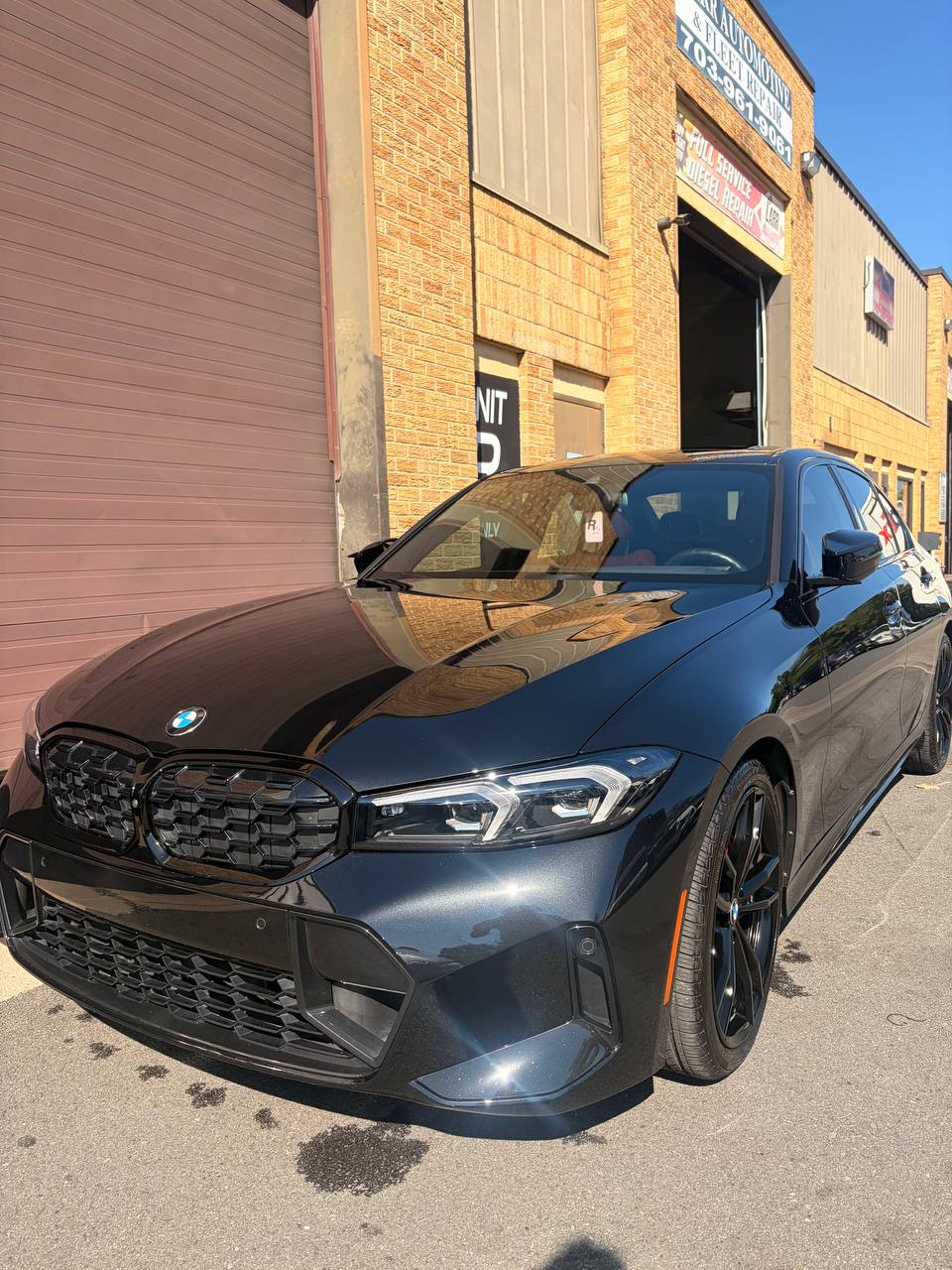
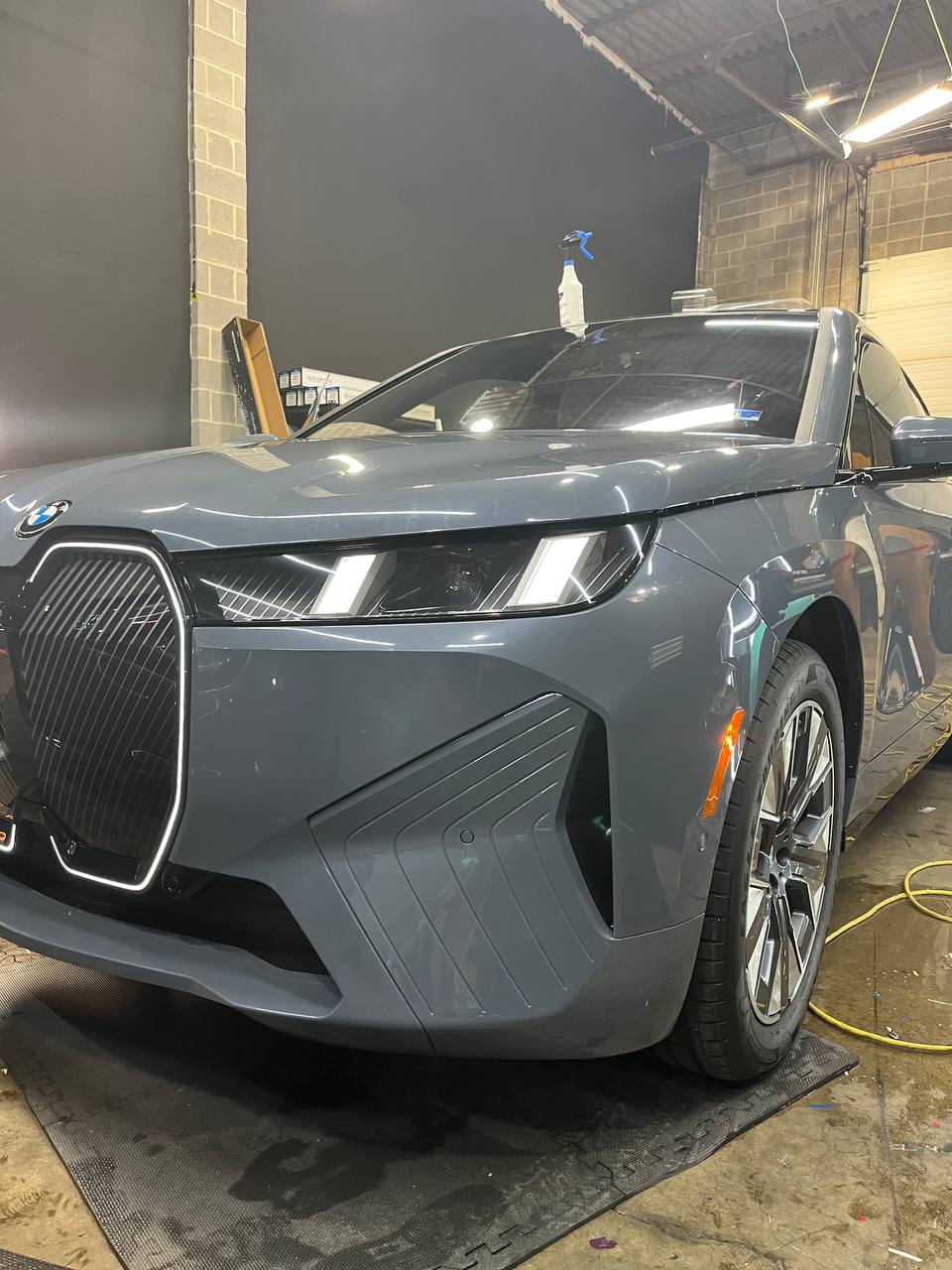
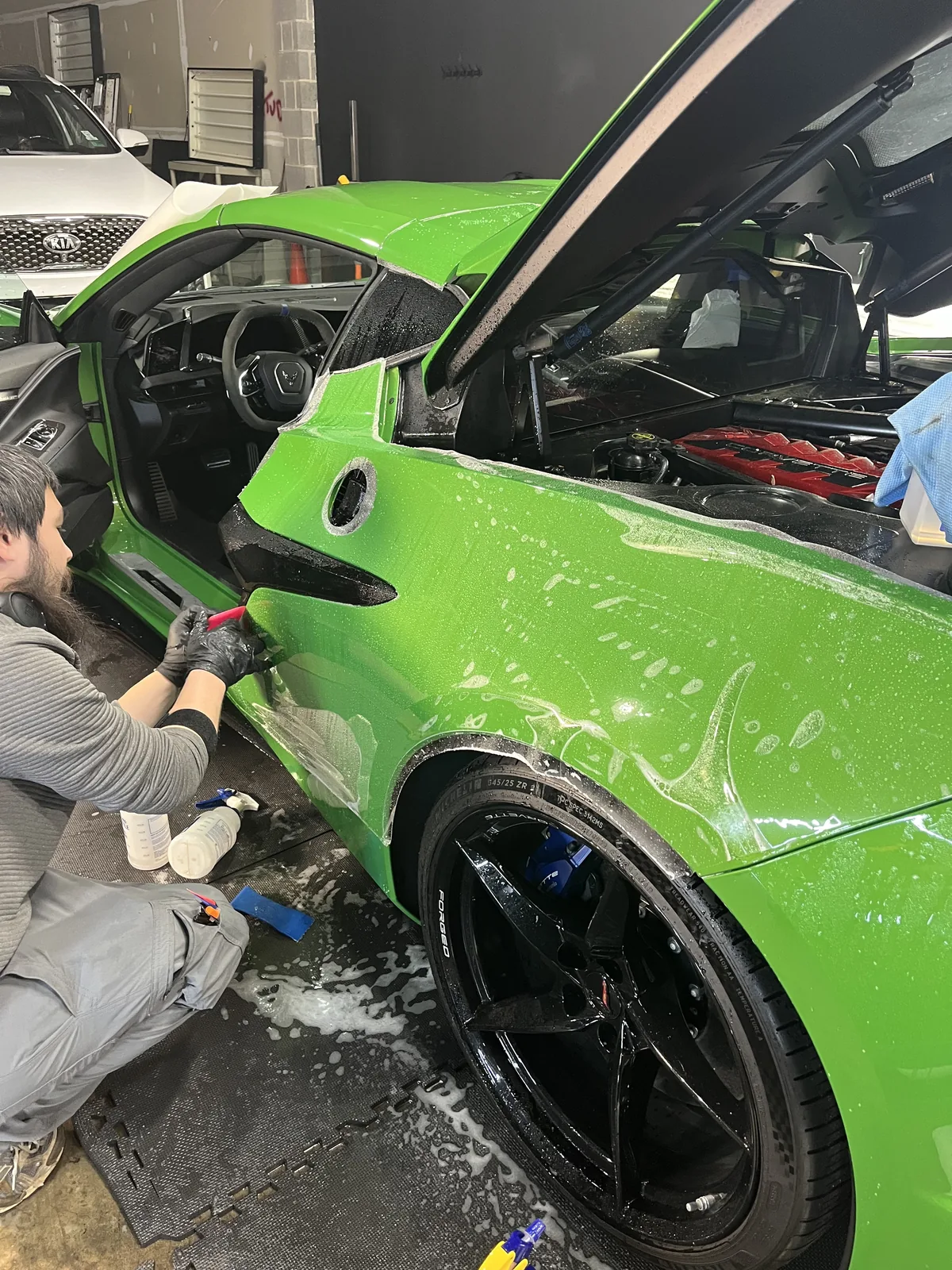
Full front PPF covers the full hood, the front bumper, both front fenders, the mirror caps, the headlights, and the A-pillars. That is every surface that faces forward and takes stones at highway speed, and nothing that does not. A tire on Route 28 or I-66 throws a stone up and back in an arc, and that arc lands on the hood, bumper, fenders, and glass, not the doors. Below is each panel in the full front PPF package, why it is there, where the film stops, and how it changes on a tall 4Runner, a low Corvette, or a Tesla.
Quick answer
- Full front PPF: full hood, front bumper, both fenders, mirror caps, headlights, and A-pillars, in computer-cut STEK DYNOshield with edges wrapped where the pattern allows.
- Not included: doors, rocker panels, roof, and rear bumper. Full front extended adds the rockers, door edges, and door cups.
- Partial front stops 18 inches up the hood. At highway speed, chips land past that line, which is why most commuters choose full front.
Panel by panel: what is in full front and why
Here is the list the way we walk it at the counter, nose to A-pillar.
- Full hood. The hood takes more stones than any panel on the car. A rock kicked up at 65 mph on I-66 arrives on a shallow arc and can hit anywhere from the leading edge to the base of the windshield. Covering the whole hood means no film line and no chip above it.
- Front bumper. The bumper is the first thing a stone meets, and it is plastic, so chips show white. It is also the most expensive panel to repaint because of the sensors, cameras, and trim that have to come off first.
- Both front fenders. Fenders take the spray from your own front tires and from the car in the next lane. The leading edge and the arch above the wheel chip first.
- Mirror caps. Mirrors stick out into clean air and take direct hits, and they are expensive to replace as a unit on cars with cameras inside.
- Headlights. Sandblasting hazes a headlight lens in a few winters of Route 28 traffic. Film keeps the lens clear, and a clear lens is a safety item.
- A-pillars. The pillars are the last forward-facing surface before the roof. Stones that skip off the hood land here.
Where the partial front hood line falls, and why chips land past it
Partial front covers the bumper, the leading 18 inches of the hood, the leading edge of both fenders, and the mirrors. We install plenty of them, but the 18-inch line is a trade-off. At surface-street speed, stones hit the bumper and the first few inches of hood. At highway speed, a stone thrown by a tire ahead of you is already a foot or two off the pavement when it reaches your car, and it is moving on a flatter path, so it clears the bumper and lands higher up the hood. We see chips above the 18-inch line on partial front cars that commute, and they always sit an inch or two past the film.
There is also the line itself. Partial front has a film edge across the middle of the hood. Under a gas-station light at the right angle you can find it. Full front has no line on the hood because the film runs to the edge and wraps under. That is the difference most people are paying for, and it is laid out side by side in our partial front vs full front PPF comparison.
If you drive 66 or 28 every day, the first chip you get on a partial front will be an inch above the film. We would rather cover the whole hood once than see you back for a repaint.
What full front does not cover, and what extended adds
Full front stops at the A-pillars. It does not include the doors, rockers, roof, or rear bumper. Those panels sit behind the front wheels, so stones from the road ahead rarely reach them. What does reach them is different: gravel your own front tires throw sideways into the rockers, shopping-cart and door-ding damage on the door edges, and fingernails on the door cups.
Full front extended is built for exactly that. It adds the rocker panels, door edges, and door cups on top of everything in full front. It is our most complete package and the right call for a truck or SUV that sees gravel, a trailhead lot near Centreville, or a lot of passengers. Install time is one to two days against one day for full front.
Edges wrapped, so the film disappears
Every full front at Skyline Customs is cut from a computer pattern for the exact year and model, in STEK DYNOshield. The pattern runs the film past the visible edge of the panel and tucks it under the hood lip, around the fender edge, and behind the bumper wherever the panel allows. Where a pattern cannot wrap, usually at a sensor opening or a tight body line, the edge follows the line so it reads as part of the panel. The result looks like clean paint: no seam on the hood, no visible edge on the fender. The film self-heals light scratches in the sun and carries a 12-year manufacturer warranty against yellowing, cracking, peeling, and delamination. Every install starts with a decontamination wash and ends with a walk-around under high-intensity lighting.
Same panels, different film: SUV, truck, sports car, EV
The panels are the same on every vehicle. The amount of film and where it works hardest are not.
Tall SUVs and trucks
A 4Runner, Tacoma, or Bronco has a tall, nearly vertical bumper and a flat hood that sits at stone height for everything a semi throws on I-66. The hood and bumper use more film than a sedan. The rocker line is long and sits in the spray from the front tires, which is why most truck and SUV owners add extended. The 2026 4Runner Trailhunter in the photo above got full front with a ceramic coating over it. Details are on our Toyota 4Runner PPF page.
Low sports cars
A Corvette C8 or a 911 sits low enough that the front splitter and the bottom of the bumper take hits a sedan never sees. Full front covers the full bumper, including the lower lip, and the long, low hood that catches stones on a flat arc. Owners who drive gravel to a cars-and-coffee often add the rockers with extended.
EVs with sensors
Tesla, Rivian, Lucid, and BMW EVs have thin factory paint and bumpers full of ultrasonic sensors, radar, and cameras. The pattern cuts around each one, and the film is thin enough that it does not interfere with driver-assist systems when installed correctly. Thin paint is the bigger reason EV owners choose full front over partial: a chip on an EV bumper goes to plastic fast. More on our EV paint protection film page.
Get a free full front PPF quote in Chantilly
If you commute on I-66, Route 28, the Dulles Toll Road, or the Beltway, full front is the package we recommend first and install most. Send us the year, make, and model through the free quote form and we reply with an exact price, usually within the hour. Pricing depends on coverage and vehicle size. A fully refundable 20% deposit reserves your install date, and Klarna, Afterpay, and Affirm payment plans are available. The shop is at 4215 Walney Rd Suite 1A & B in Chantilly, VA, off Route 28 near Dulles, with 140+ five-star reviews on Google. Our paint protection film service page covers all three packages.